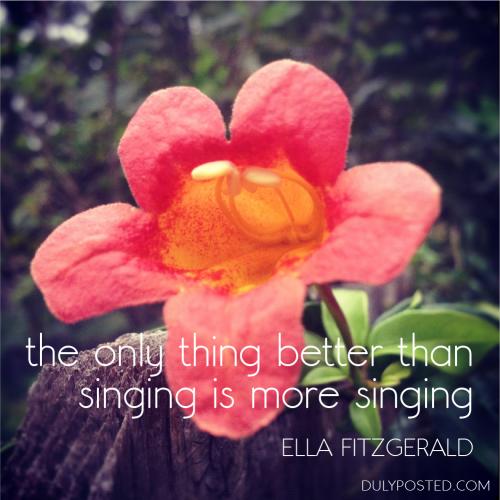
Music is for everyone
Image
Reply


If you feel led to do something in music, and to be a good singer has been one of your frustrations, think again. Here are some voice singing tips that will help. Most professional singers are not born stars. That should be encouraging to you and not hinder you from pursuing your dreams. The fact remains constant – everyone can be a great singer regardless of age or anything. Just consider the singing tips given below that will help you to keep your enthusiasm about singing.
Tip 1: Decide whether you want to hire a singing coach or just purchase some good singing software. There are always advantages and disadvantages between the two options. A guide from a professional is always better than to work on your voice alone. But, the availability and your convenience are always at stake.
Now, if you know your capacity and you can learn better even without a coach, then buying singing software could be best for you. But, you have to monitor your progress alone or record every practice and later on ask someone who knows something about singing to get their feedback. That way you can track your rate of improvement.
Tip 2: It’s always good to get some inspiration from your favorite singer. On the other hand, if you feel sure that you want to make it in the singing industry, you have to find ways to be unique that will separate you from others. Choose songs best for your voice, your own style of music and experiment on having a different singing style that will create your own identity.
Tip 3: Take care of your asset. If for example, you gain the level of being a professional singer and you really have what it takes to be a star, never ever take for granted your voice. Smoking can worsen your voice and you are more likely to increase the rate of throat cancer. Same thing with alcohol, avoid any alcoholic drinks and caffeine because there is a tendency that your voice may get irritated.
Drinking lots and lots of water is best recommended, warm water to be in particular as cold drinks can also irritate the vocal cords. Last, don’t misuse your vocal cords like doing unnecessary loud talking. Let your voice rest, your vocal cords deserve a quality break.
Tip 4: Pay attention to all of the singing techniques and make sure you do them the right way. It’s very easy to determine whether you are doing it wrong, if you are straining your voice. Properly breathing to produce quality in your voice is always the primary concern, the correct posture, placing the tongue and soft palate in the right position, hitting the right key, improving vocal range, and many other essential techniques that every singer has to know are very important lessons that need to be taken seriously.
Tip 5: Practice, practice, and practice to master your craft. Even if you feel that you are a very confident singer. Make sure to do the warm ups properly, do the routine correctly, and never forget to do the cool down exercise right after the routine.
Want to learn more about exercises to improve singing [http://www.singinglessonstips.com/exercises-to-improve-singing]? Visit Joe’s website and get your free email course [http://www.singinglessonstips.com] and learn the techniques that the pros use.
Article Source: http://EzineArticles.com/?expert=Joe_Glavosek

It is often easy to forget how physically demanding playing the guitar can be. It is not uncommon to see guitar players who are suffering from a variety of problems, including tendonitis (an inflammation of the tendons) and carpel tunnel syndrome (when the median nerve is compressed at the wrist, leading to pain, paresthesias, and muscle weakness in the hand).These can be debilitating problems, but they are preventable. There are some important things you can do to protect yourself from having these problems now or later down the road.
First and foremost it is important to stretch before you play or practice, which not only helps to prevent injury, but will also allow you to play more effectively.
The best way to do this is to start off by stretching the fingers one by one.
Start by placing your left hand thumb against your right hand palm and pushing back slightly, not so far that it hurts but far enough so you can feel a stretch. Hold for about 30 seconds. Do this with the rest of your fingers on your left hand, and then repeat the same stretch for all the fingers on the right hand.
This next stretch is great for both your wrists and your forearms. Start by putting your palms together in front of your chest. Slowly push out your elbows and bend your wrists, holding once you feel a good stretch. Next, rotate your wrists forward so your fingers are pointing away from you. Stop and hold when you feel a stretch. After stretching it’s always a good idea to warm up by practicing a few scales, riffs, or chords.
There are some things to keep in mind when you are playing that can help to prevent any problems. First of all, try to keep your wrists as straight as possible when you are playing. When your wrists are bent it will cause unnecessary strain, and also makes it harder to move your fingers. While there are some chords or passages that require you to bend your wrists slightly, it will be better in the long run if you can keep them straight for as long as possible. Just do your best. Also, try not to press on the strings any harder than is absolutely necessary, as doing so will cause a great deal of strain.
Another important tip is to take a break. 15 mins for every hour of playing should do, but take a longer break if you have to. And if you feel any pain or discomfort whatsoever while playing it is important to stop. Trying to play through the pain will only make things worse, so do yourself a favour and stop as soon as you feel any discomfort.
Take care of your hands and wrists and you will be able to experience the joy of playing the guitar for many years to come.
Michelle is a guitarist from Québec, Canada. She is currently completing the master certificate program in guitar at the Berklee School of Music in Boston.
If you liked this article and would like to read more, then head on over to Michelle’s blog, The Guitar Player’s Guide.
Article Source: http://EzineArticles.com/?expert=Michelle_Monette

Will my child become the next big star?
As a parent, you have high hopes and expectations for you child. That’s perfectly natural. You want your kid to do better and to achieve more than you did. Basically, you want what’s best for them.
I talk a lot about how music education can bring prosperity to your child’s future. I would like to clarify what I mean by prosperity.
What I mean by prosperity is that music education will develop the skills necessary to succeed in life, regardless of what career your child chooses.
I don’t want anyone to be confused here. What I don’t want people to think is that music education will bring your child prosperity in the form of becoming a famous singer or musical artist. This is not the goal of music education. For me, prosperity is not becoming a celebrity.
The Meaning Of Prosperity Through Music
Prosperity is an advantageous situation where your child will get the most out of his/her education, and enter the working world with the skills that will be required in the future global economy.
It has been scientifically proven that music education increase test scores in Math, Science, and Reading. But besides test scores and grades, your child would actually develop an understanding of those subjects that noticeably surpasses their non-musical peers. I can tell one thing with the utmost certainty: there will be jobs for people that have skills in those areas.
Beyond those three subjects, music education develops social and emotional intelligences, which are highly important in the working world. We all know what it’s like in the work place. It can be a tough social environment. It’s tough to get along with co-workers from time to time. It’s tough to convince your boss that you deserve a raise. It’s tough to convince your manager of your ideas and how they can benefit the company. There are a million scenarios where social skills will really be useful in achieving your goals. Developing these skills give a person an advantage to succeed in the work place, not to mention building relationships and friendships.
What Kind Of Mind Will Be Valuable In The Future Economy?
Another huge bi-product of music education is developing the creative side of the brain. Creative minds are needed in today’s technology-driven, globally-connected economy, and they will surely be needed in the future. One of the biggest drivers of an advancing economy is innovation. Without creativity and new ideas, an economy would completely stagnate. That means less jobs for everyone. Those who can create will have a place in the future economy.
Your Child Will Succeed In Life
The most important idea that I want you to walk away with from this article is that music education will develop a portfolio of skills necessary for your child to prosper and succeed in life. The goal of music education is not to become a big star or famous musical artist, or even a singer. That’s not the prosperity I’m talking about. The skills that music education teaches can be used in any profession that your children chooses when they grow up.
Economic prosperity in the future will be for the people with the most skill sets. Take action in getting your child started in learning a musical instrument. Your child’s education will be enriched and he/she will be on a path towards that end goal of economic prosperity that begins with developing a bright mind.
Tony Margiotta is the founder of The Musiconomy, a publishing company advocates musical training as an essential focus in childhood education and development. Sign up for the Free monthly newsletter and special report here:
http://www.themusiconomy.com/newsletter.html
Tony is the author of “A Parent’s Guide: How To Get Your Child Started In Music,” a step-by-step approach that takes you through the process of inspiring musical interest in your child, to making the correct instrument and book purchases, and finding the right teacher. Full of tips, checklists, and more. [http://www.tonysmusicbooks.com/Parents-Guide-Deluxe-Version-Ebook-MP3-201101.htm]
Article Source: http://EzineArticles.com/?expert=Tony_Margiotta
from The Sunny Side – wishing everyone a beautiful day – S

Presenting itself through a number of signs and symptoms, performance anxiety is a social anxiety disorder that affects people who perform in public for example; singers, actors, musicians, and public speakers or master of ceremonies. Your child may also experience this condition if s/he is made a part of the debate team or a part of the school play or such similar part. The most common root cause of this ailment is feelings of inadequacy on the part of your child. This article will reveal 7 of the most common triggers that you can learn to recognize and know if your child is suffering from performance anxiety (PA)…
1. Stage Fright…
This is one of the most common indicators of this performance anxiety according to author Martin Richfield. It mostly occurs in the form of a paralyzing fear and immobility. Your child becomes unable to move or speak; this scenario is mostly brought on due to your child’s irrational fear of humiliation or rejection by his or her classmates or playmates.
2. Lack Of Concentration…
Another common sign of PA in your child is his or her inability of to concentrate. Becoming confused of losing focus are results that can be directly traced back to feelings of fear or apprehensive thoughts which may have overtaking your child’s mind and affected his or her ability to complete the present task at hand.
3. Perspiration…
Excessive swearing from various orifices in your child’s body, particularly your hands, feet and face, is another sign that s/he might be experiencing a bout of performance anxiety. What occurs is that the brain sends signals to the body which causes “hot flashes” and results in a large volume of perspiration due to emotional stress. When this occurs, your child begins to feel uncomfortable and self-conscious.
4. Quivering…
Shaking or quaking uncontrollable is a common occurrence while experiencing PA. This shacking generally occurs around your child’s hands and knees. Adrenaline is sent through your child’s body as a defense mechanism which results in uncontrollable quivering. This is also referred to as “fight or flight” mode.
5. Dyspnea…
More commonly referred to as shortness of breath, is a very common occurrence while experiencing a bout of PA. Hyperventilation, gasping for air, an increased heart rate etc are all linked to dyspnea and occurs when your child is afraid of performing.
6. Lightheadedness…
While performing your child may become woozy or faint headed, this dizziness is a typical sign of performance anxiety and can cause your child to lose his or her balance. This is due to the brain not getting the required amount of oxygen and blood needed to function properly. Your child may begin to see a spinning hall or room and can potentially faint if the anxiety is intense.
7. Adrenaline Rush…
You will know this through your child’s increased heart rate. While experiencing PA, adrenaline will be released into your child’s body as a survival response, which is what causes the increased heart rate; in fact, the more afraid your child becomes, the faster his or her heart will beat.
Ty Lamai is an avid researcher and writer with in-depth knowledge spanning a wide variety of topics. He has hundreds of articles published online and has a blog dedicated to info about performance anxiety in children [http://analyze-more.com/anxietyblog/how-to-treat-performance-anxiety-do-this-and-your-next-performance-will-be-a-hit%e2%80%a6guaranteed] which you should visit today.
Article Source: http://EzineArticles.com/?expert=Ty_Lamai



 Sunny's Music Studio :) Professional Music Lessons now Online !